Eyewear & Contact Lens Sale On Now
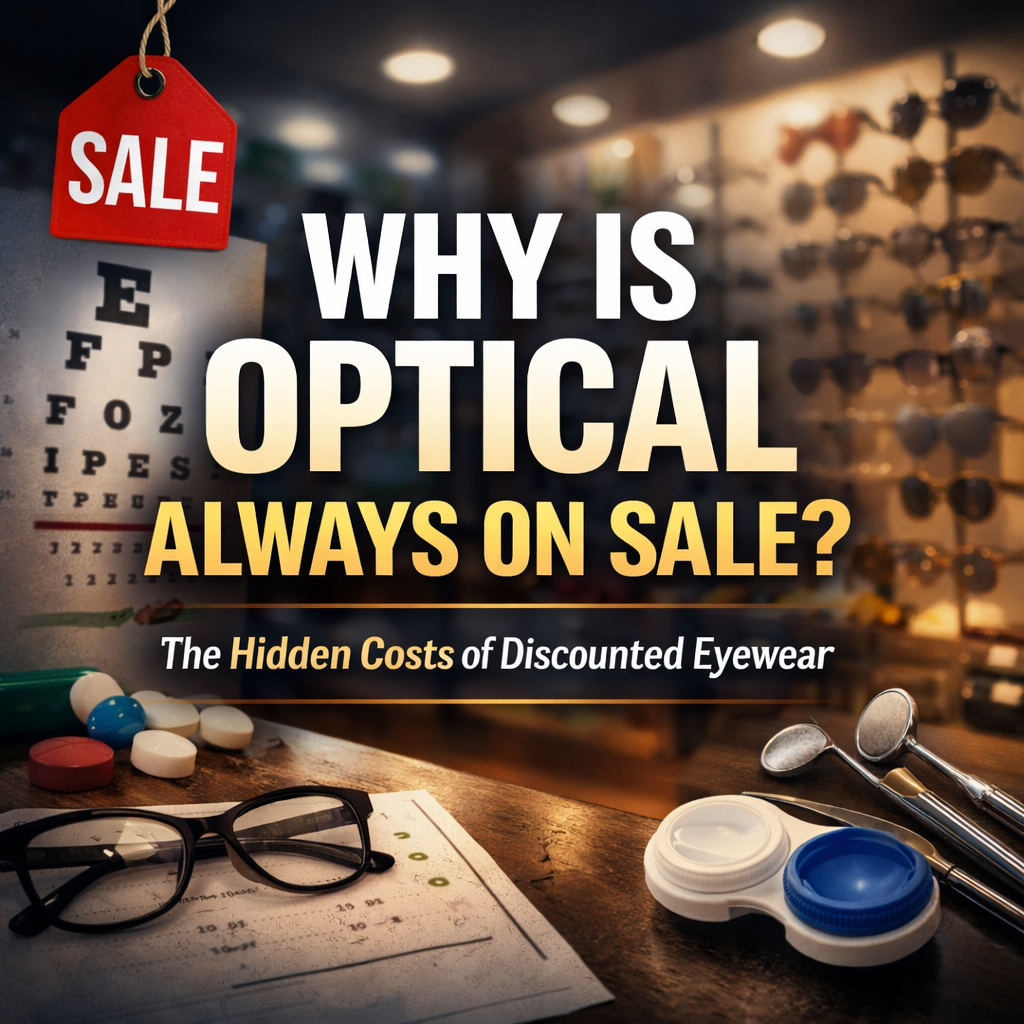
Walk through any mall, scroll Instagram, or drive down a main road in Edmonton, and you will see it.
Eyewear Sale.
Glasses Sale.
Contact Lens Sale.
Ends Soon.
Final Days.
Extended Again.
Somehow, the same few optical clinics always seem to be “on sale.”
That alone should make you pause.
The Optical Sale That Never Ends
In most industries, a sale is exactly that—temporary. A clearance. An overstock issue. A seasonal promotion.
In eyewear, however, many “sales” are permanent fixtures.
Frames marked up, then marked down.
Packages are created, so discounts are hard to follow.
Prices inflated just enough to make the savings look dramatic.
If an eyewear sale has been running for six months, it is no longer a sale. It is simply the price.
Why This Matters More Than People Think
Eyewear is not a disposable fashion item. It is a medical device that most people rely on every waking hour of the day.
If your vision is blurry, strained, or no longer functioning as it should, the solution is care, not waiting for a sale. We do not delay blood pressure medication until it’s discounted. We do not postpone treating a dental infection until there’s a promotion. Delaying treatment is bad medicine. Yet in eye care, people are routinely encouraged to wait for the sale.
The lenses you wear determine how clearly you see, how comfortable your eyes feel, how much fatigue you experience, and how accurately your prescription performs in real-world conditions. When pricing becomes the main marketing message, something else usually gets pushed into the background:
Lens or frame quality
Proper measurements
Customizations
Long-term comfort and durability
Follow-up care
The problem is not the discounts themselves. The problem is when discounts become the business model.
The Math Behind Perpetual Eyewear Sales
Here is the part most people do not see.
To run eyewear sales constantly, prices must first be high enough to absorb the discount. That means:
The “regular price” was never realistic.
The sale price was planned from the start.
The margin still has to come from somewhere.
That margin does not disappear. It is engineered into both the product and the process.
On the product side, it often means relying on simpler lens designs rather than ones optimized for how someone actually uses their eyes. Advanced lens technology, higher-end coatings, and individualized parameters cost more to produce, and they are harder to discount endlessly without consequence.
On the process side, it changes how care is delivered. Appointments become shorter. Measurements are standardized or removed (told they’re not required) rather than customized. The goal shifts from precision to efficiency. Staff are trained to move volume, not necessarily to solve nuanced visual problems.
None of this is obvious when all you see is a big percentage sign in the window.
A discount can hide a lot. What it cannot hide forever is how eyewear actually performs over months and years of daily use. Comfort, clarity, and visual endurance tend to reveal whether the savings were real or merely transferred elsewhere in the experience.
Contact Lens Sales Work the Same Way
Contact lens sales are not immune to this model either.
A box is advertised as “on sale,” but the discount is often funded by the manufacturer through rebates or bundled pricing, making a true comparison nearly impossible. You are not necessarily getting a better product—just a better-sounding headline.
What is often overlooked is that your optometrist is rarely the highest-priced option in this market. Clinics have access to the same pricing information as online retailers and routinely monitor internet pricing. Many offices also offer instant or mail-in manufacturer rebates that can significantly reduce the final cost. In some cases, your optometrist may actually be the least expensive contact lens supplier in town.
Before assuming you are saving money elsewhere, do yourself a favour and get a quote. You may be overpaying by hundreds of dollars when purchasing from large retailers, online platforms, or membership warehouse stores without realizing it.
A Different Perspective on Value
This is where my opinion may differ from traditional optical marketing.
The best eyewear value is not found in a countdown timer or a flashing banner. It comes from:
A prescription that is checked properly
Lenses selected for how you actually use your eyes
Accurate measurements taken by someone who knows why they matter
Frames chosen for fit, comfort, and durability, not just price
Products that last, not just ones that sell fast
Ironically, when you strip away artificial markups and constant “sales,” pricing often becomes more honest — and more predictable.
So, Is This an Eyewear Sale or Not?
Yes… and no.
There are times when promotions make sense. Manufacturer incentives, insurance timing, slower times of year when clinics are trying to keep busy, and seasonal events can all create legitimate opportunities for savings. In those situations, a sale is temporary, specific, and tied to something real happening behind the scenes.
The concern is not the existence of sales. It is their permanence.
If an eyewear sale runs occasionally, it feels reasonable. If it runs constantly, it raises a different question altogether. When the same banners, slogans, and discounts appear month after month, year after year, the word “sale” starts to lose its meaning.
At that point, it is worth pausing and asking a simple but important question:
“If this is always on sale, what is the real price?”
The Attention Economy of Modern Eyewear
With more online opticals entering the retail eyewear market, we are seeing increasingly large marketing departments competing aggressively for attention and spend. Messaging is tested, refined, and repeated across social media, search results, and inboxes, often built around urgency and price. The transaction experience is designed to feel simple and decisive, removing friction and shortening the time between seeing an ad and completing a purchase.
In that environment, the role of the optometrist or optician is often squeezed out of the conversation altogether. Instead of guiding decisions, they are left responding to marketing claims after the fact, explaining limitations, correcting expectations, or defending why a more thoughtful recommendation costs more than what was promised online. The expertise that should be shaping the decision ends up reacting to it, rather than leading it.
The Takeaway
Eyewear should not feel like buying a used car.
When price is the only thing being advertised, it is worth asking what that says about the product itself.
If the strongest message is the discount, there is often very little else to talk about. Eyewear is not something you use once and forget; it is something you wear every day, often from morning until night. For most people, that means the same glasses or contact lenses for roughly the next 730 days, until your insurance renews or benefits reset.
Comfort, clarity, durability, and how well the lenses actually perform in your real life matter far more over time than a short-term price reduction. It is surprising how rarely the conversation focuses on what you are committing to wearing on your face every single day for the next two years, rather than what you happened to save at the checkout counter.
You should understand what you are paying for, why it costs what it does, and how it benefits your vision. Transparency builds trust. Endless discounts erode it.
So the next time you see an “Eyewear & Contact Lens Sale On Now” sign — including this one — look beyond the headline.
✔Ask better questions.
✔Expect clear answers.
And remember that the best value in eyewear is rarely the loudest.

Disclaimer: The content provided on this website, including blog posts authored by Dr. Ross McKenzie, is intended for general informational purposes only. It does not constitute medical advice, diagnosis, or treatment, and should not be relied upon as a substitute for consultation with a licensed optometrist or healthcare provider. No doctor-patient relationship is established through the use of this website or its content. The information shared is not intended to endorse or recommend any specific medical treatments or guarantee outcomes. Users are encouraged to consult their own healthcare providers regarding any health concerns. The team at drrossmckenzie.ca does not assume liability for any decisions made based on the information provided. Use of this website is at your own risk.

Hey there, I’m
Dr. Ross McKenzie
I’m an Edmonton-based optometrist who believes clear vision is about more than just eyesight — it’s about seeing your life, your work, and your health with clarity.
I love smart tech, sharp lenses, and helping people show up fully in every part of their day — whether that’s behind a desk, behind the wheel, or on a ski hill.
My Mission? To bring real, honest eye care to real people — with a side of science, strategy, and style.